Treatments and gifts
Gift cards or treatment vouchers? Which to use, and when
Both arrive at the counter as a slip with a code on it, so it is easy to treat them as the same thing. They aren’t. A gift card is money a customer has already paid you. A treatment voucher is a promise the shop chose to make. Mixing them up muddles your takings, your commission and what you owe. Here is how to tell them apart and when to reach for each.
By The Zero POS teamChecked 6 min read
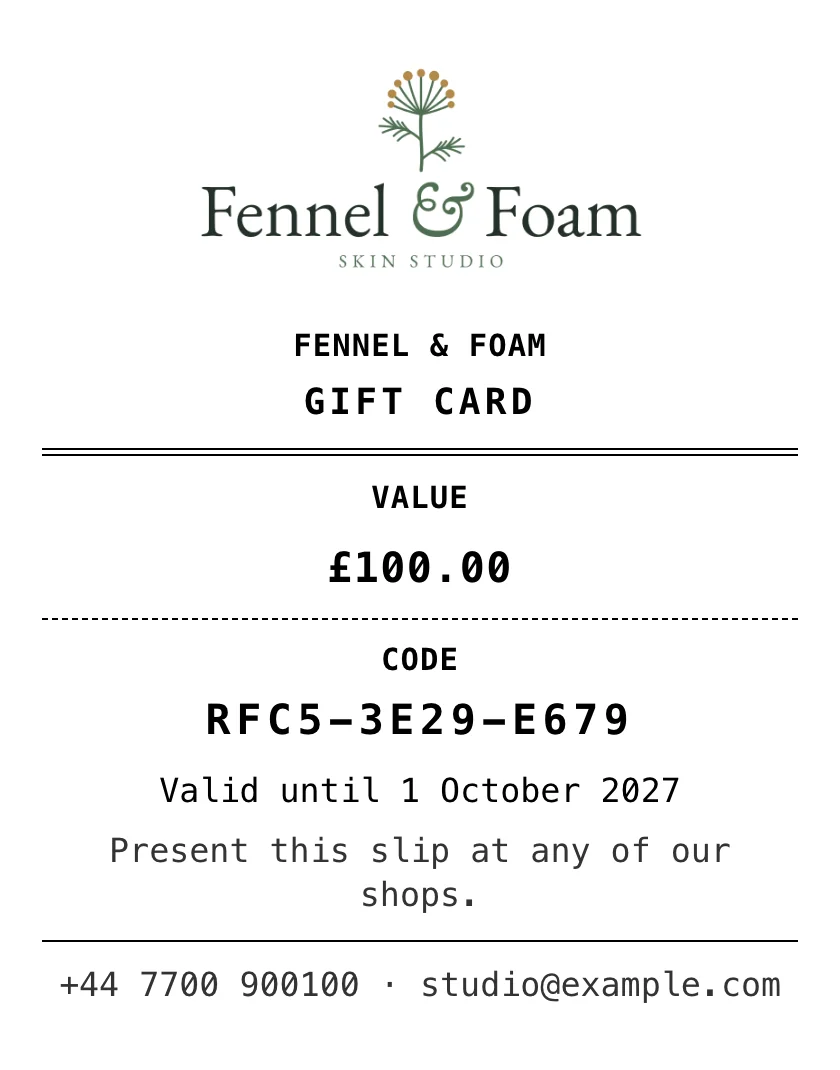
A printed gift card slip: the shop’s logo, the value and the code. Whoever holds it spends it later, in one visit or several.
Two different promises
A gift card holds money. Somebody pays for it today, usually to give to someone else, and whoever holds the slip spends it later on anything you sell, in one visit or several, until it runs out or expires. The money is already in your till; what you owe is the goods.
A treatment voucher holds a treatment. The shop gives it, usually as a thank-you or with a purchase, for one named treatment: free, with an amount or a percentage off, or at a set price. No money came in when it was issued; what you owe is the room, the therapist’s time and the products when it is used.
Everything else follows from that difference: how each is counted, who earns commission, what it costs you, and what happens when a slip is lost.
When a gift card fits
- A customer wants to give a present and let the other person choose: a cream, a set, a facial, or a bit of everything.
- A customer wants to give a particular treatment to someone else. Sell a gift card for the treatment’s value: the money is paid today, and the person can book and spend it when they like.
- Christmas, Mother’s Day and birthdays, when people want a present they can buy in one minute at the counter.
- A business buying presents for its staff or clients, in round amounts.
Set the amounts you offer at the till so they match your menu: an amount that covers a popular facial, one that covers a facial and a product, and a small one for a stocking filler. People choose from what they are offered.
When a treatment voucher fits
- A thank-you to a regular, or an apology when something went wrong.
- A gift with a purchase: buy the serum, get a facial free or at a lower price, so the customer comes back and tries the treatment room.
- Winning back a customer who hasn’t been in for a while.
- A prize for a local raffle or a charity evening, where the shop is giving and nobody is paying.
A voucher is a marketing tool, so treat it like one. Decide which treatments you are happy to give, on which days, and how long a voucher lasts. Give vouchers for treatments that sell the products used in them, and for times when the diary is quiet.
What each one really costs you
A gift card costs you nothing extra: the customer paid full price, and when it is spent you hand over goods or a treatment you would have sold anyway. Some cards are never fully spent; don’t plan your year around that, and treat any amount left on a card as something the shop still owes until its date passes.
A treatment voucher costs what the treatment costs you to give, not its menu price: the therapist’s time, the room and the products. A free facial whose menu price is 60 might cost you 35 to give. That is the figure to weigh against what it brings back: a customer who returns, a product sold on the day, a friend told about the treatment room.
Keep both in view. Know how much your shops still owe in goods on sold cards, and how many vouchers are out there waiting to be used, and for which treatments.
Commission and takings
Count a gift card’s money once. The simplest rule is to count it on the day the card is sold, and pay the seller commission then; when the card is spent later it simply pays for the goods, and nobody earns commission on the same money twice.
A treatment voucher brings in no money when it is issued, so it adds nothing to the takings and earns no commission. If the voucher leaves something to pay, a price or the rest after an amount off, that part is sold at the till like any other treatment and counts as a sale.
How a gift card is treated for tax in your country is a question for your accountant. What matters at the counter is that the till records it the same way every time.
Expiry dates, lost slips and refunds
Give both an expiry date and print it on the slip. Check what your country’s rules say about how short a gift card’s life may be, and be generous: a card that expires before anyone has had a chance to use it makes an unhappy customer out of a present.
Slips get lost. Because every code is recorded, a lost card or voucher can be stopped so nobody else can use it. Make sure your team knows that a gift card’s code is shown once, on the slip, and that it should be printed before the window is closed.
Decide your refund rule in advance and say it at the counter. The safest rule is that a sale paid with a gift card is final: the card was the shop’s own money, and giving it back in cash is how customers end up paid twice.
A quick way to decide
Is someone paying for it now? Then it is a gift card.
Is the shop giving it, with no money coming in? Then it is a treatment voucher.
Is it for one particular treatment someone else is paying for? Sell a gift card for that treatment’s value.
Is it a thank-you, an apology or a gift with a purchase? Issue a treatment voucher.
Doing it in Zero POS
The steps are in gift cards, treatment gift vouchers and treatments at the till. Both kinds of gift, side by side, are on the gift cards and vouchers page.