Money at the till
How to cash up, and find out why the till is short
A till that comes up short is often not a thief at all. It can be a float counted twice, a card payment rung up as cash, or a refund nobody recorded. Cash up the same way every night and a shortfall usually explains itself before anyone goes home.
By The Zero POS teamChecked 6 min read
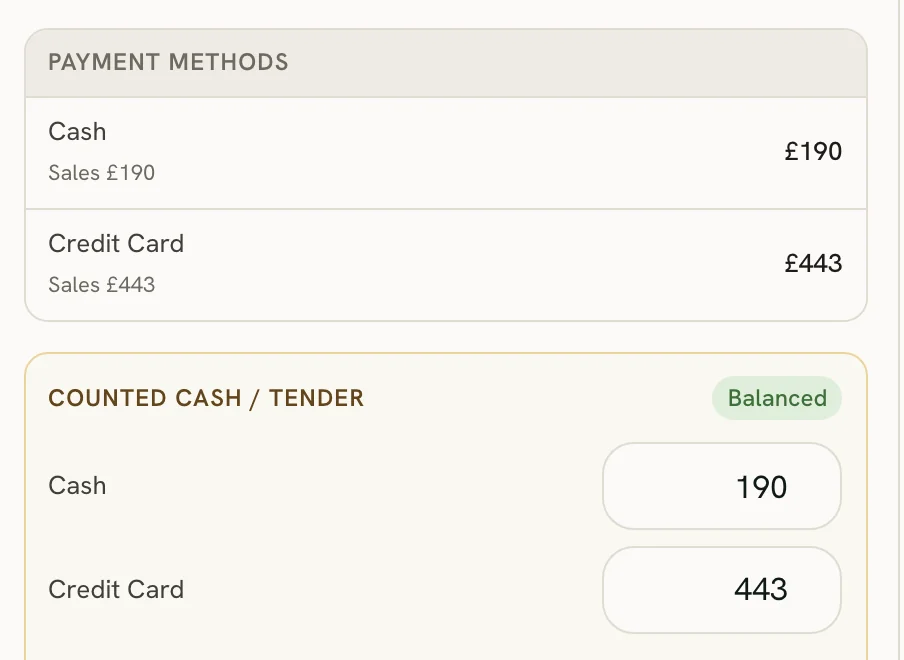
The count at the close: what each way of paying took, and the cash and card counted against it.
Why cash up every single day
Cashing up compares two stories about the same day: what the till says was taken, and what is actually in the drawer and on the card terminal. When they agree, you know the day’s sales are real. When they don’t, you want to find out that evening, while everyone still remembers the customer who paid half in cash, or the refund given just before lunch.
Leave it a week and the trail goes cold. A difference found on Friday for Tuesday’s takings is almost impossible to explain, so it gets written off, and a habit that loses money stays hidden. Each shop should close its own day, with its own count, so one shop’s shortfall never disappears into another’s takings.
Before you count
Three things decide whether the count can match at all. Get them right first.
- Take the opening float out. The till expects only today’s takings. Count the float in and the cash reads over by exactly the float; forget to put the float in the morning count and it reads short by it.
- Have the card terminal’s end-of-day total to hand. Card payments need checking too, against the terminal, not against memory.
- Know what the till expects for each way of paying. Only money actually taken today counts: a layaway counts the deposit or instalment paid today, not the whole ticket, and a gift card being spent is its own way of paying, not cash.
Count somewhere calm, away from the counter, and if you can, with the door locked. Interruptions are the commonest cause of a miscount.
How to cash up, step by step
Read the day’s report first: sales, refunds, each seller’s total and what the till expects for every way of paying.
Take out the float and set it aside for tomorrow, counted.
Count the notes by value, then the coins, and write each total down before adding them up.
Compare the card terminal’s end-of-day total with what the till expects for card.
Check any other way of paying the same way, such as bank transfers, against what actually arrived.
Compare method by method. If everything matches, close the day and keep the slip.
If something is off, recount that method before doing anything else.
Counting method by method matters more than the grand total. A drawer that is 20 short in cash while the card total is 20 over is not short at all: one sale was recorded under the wrong method. The grand total would have told you nothing.
If you still count on paper, our free cash-up sheet has a line for every denomination, the float and each way of paying, with room for two signatures.
Over is a problem too
A till that comes up over feels like good news. It isn’t. Money you didn’t expect is money that was recorded wrongly somewhere: change not given, a sale rung up at the wrong price, a payment taken twice, or cash that belongs to tomorrow’s float. Treat over the same way as short: find out why, and correct the record.
The usual reasons a till is short
Work down this list in order. It goes from the most common and easiest to check, to the least.
- The float. Counted into the takings, taken out twice, or a different amount from the one noted in the morning.
- The wrong way of paying. A card payment rung up as cash, or the other way round: one method short and another over by the same amount.
- A split payment typed wrong. Part on card and part in cash, with the amounts swapped or mistyped.
- A refund given in cash but not recorded, or recorded as a card refund when the money came out of the drawer.
- Cash taken out for the shop: a delivery paid at the door, cleaning supplies, coffee for the team. Spent and never written down.
- A sale not rung up at all, or rung up twice: look for a duplicate ticket just after another one.
- A layaway: the full ticket expected instead of the deposit actually paid.
- Wrong change. Usually small amounts, and often on a busy day with a queue.
- Theft. It happens, but it should be the last explanation, reached only after everything above has been ruled out.
How to find the difference
Start with the size of the gap. A round amount, a note’s worth, points to a miscount or a note in the wrong place: recount. An amount that matches a ticket points to a sale under the wrong method or rung up twice: go through the day’s sales for that method and look for it. Matching opposite differences on two methods almost always mean one sale recorded under the wrong one.
Then look at the refunds and anything taken out of the drawer. Ask the people who worked that day while it is fresh, and ask openly: the point is to find the mistake, not a culprit.
When you find it, correct the record, not the count. If a card sale went through as cash, the sale is changed to card; if cash went on a delivery, it is logged as an expense. The counted figure stays what was really counted. A cash-up that is made to balance by typing in the expected numbers is worse than no cash-up at all: it tells everyone the day was fine and hides the next mistake too.
Some differences won’t be found. Write down what was counted, what you checked and what you think happened, and tell whoever runs the shop. Small, rare, unexplained differences are normal; the same difference on the same day of the week, or the same person’s shifts, is a pattern worth looking at calmly.
Doing it in Zero POS
In the morning, open the day with the Opening float, and the float stays out of the evening count by design. Opening and closing, the slip and where the money goes afterwards are all on the cash-up page.