Team and pay
Beauty therapist commission explained
Commission is meant to reward the people who sell, and it does, as long as everyone can work out what they will earn before the month ends. Arguments about commission are often not about the rate. They are about a refund, a shared customer or a gift card nobody thought about when the rule was set. Here is how the parts fit together.
By The Zero POS teamChecked 6 min read
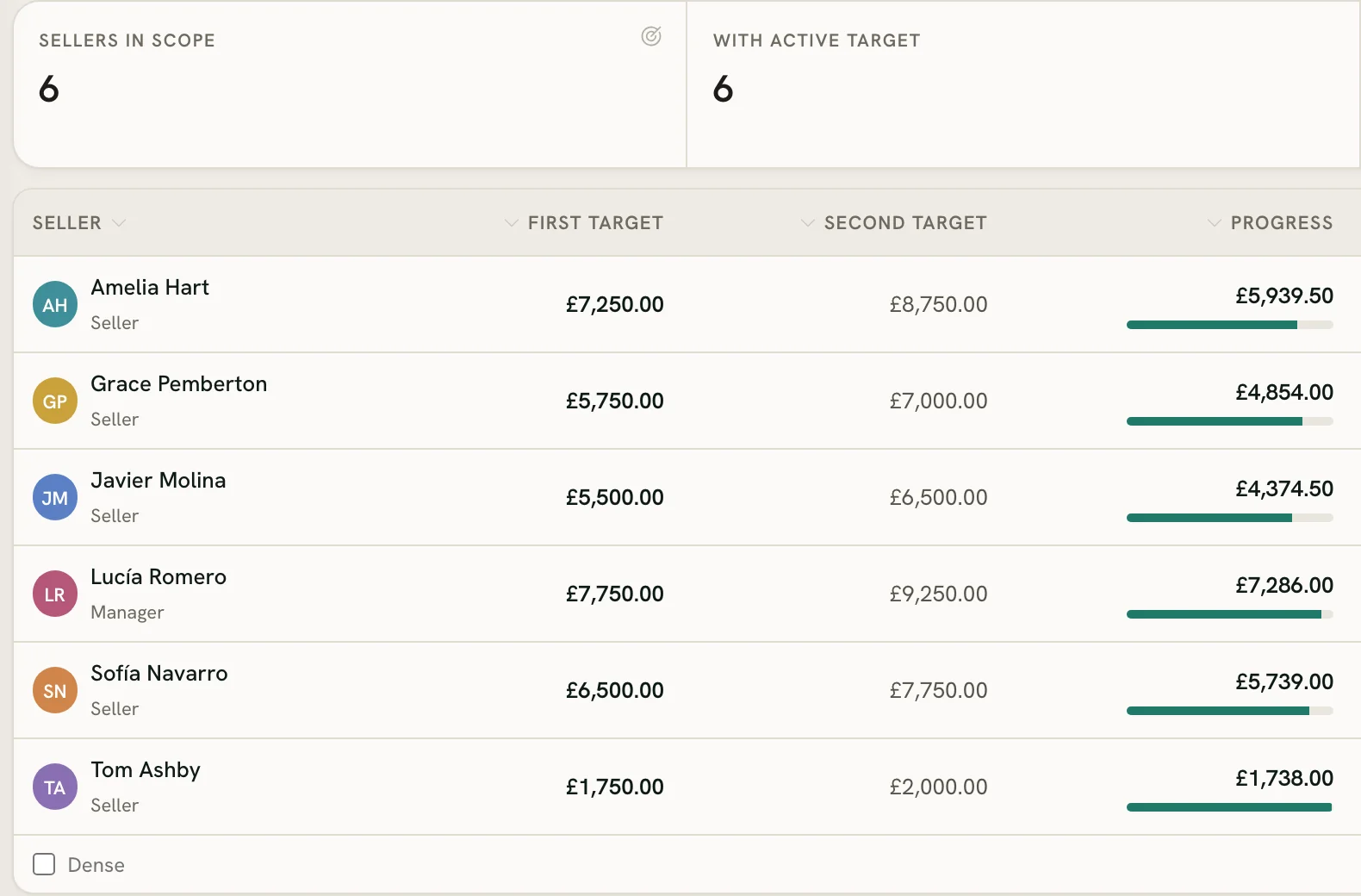
Each seller’s target and how far they have come. Targets show progress; pay comes from each person’s hourly rate and commission tiers.
Three ways to pay a therapist
Beauty businesses tend to pay their therapists and sellers in one of three ways.
- Hourly only. Simple and predictable, and nothing rewards selling. Good for roles that don’t sell, or for a team still learning.
- Hourly plus commission. A base for the hours worked, and commission on top. The most generous for the team and the most expensive for the shop.
- The higher of the two. Each month, the person gets either their hourly pay or their commission, whichever is more. A quiet month is protected by the hourly rate; a strong month is paid by commission.
Whichever you choose, check what your country’s employment rules require, such as a minimum wage for the hours worked or how commission must appear on a payslip. This guide explains the arithmetic, not the law.
Flat rates and tiers
A flat rate pays the same percentage on everything: 10% of sales, say. It is easy to explain and easy to check, but it rewards a slow day and a record day in exactly the same way.
Tiers pay more as sales grow. A tier covers a range of sales, from one amount to another, and carries its own rate: for example, up to 400 at 25%, and from 400 upwards at 27%. Tiers give people a reason to sell the extra serum at the end of a facial, because it might lift them into the next band. A tier can also pay a fixed bonus instead of a percentage: reach 600 in a day and earn a set amount.
The two ways a tier can pay
This is the part commission arguments often come from, so decide it on purpose and write it down. Once someone crosses into a higher tier, the higher rate can apply in one of two ways.
- On the whole amount. Reaching the next tier lifts everything to its rate. With the tiers above, a day of 800 earns 27% of 800, which is 216.
- Only on the part above the line. Each slice earns its own rate. The same day earns 25% of the first 400, which is 100, plus 27% of the other 400, which is 108: 208 in all.
The first is more motivating near the line and can feel generous; it also means a single sale can change a day’s pay by more than the sale itself. The second is smoother and cheaper. Neither is wrong. What causes trouble is a team that assumes one while the shop pays the other. Our free salon commission split calculator shows both side by side for your own figures.
Daily or monthly
Tiers also need a period: do they reset every day, or does the whole month count together?
With daily tiers, each day stands alone. A big Saturday can’t make up for a slow Tuesday, so people are rewarded for selling well on every shift they work, and someone who works fewer days isn’t at a disadvantage on the days they do. Set the tiers around a normal day’s sales, so the higher band is within reach on a good day.
With monthly tiers, everything adds up first. One exceptional day lifts the whole month into a higher band, which can feel like a windfall and can also be lumpy for the person and the shop. It also favours whoever works the most days.
What counts as a sale
Write down the answer to each of these before the first payday. They are where the disagreements live.
- VAT. Commission is fairest on the sale without VAT: the VAT was never the shop’s money. In a shop that charges no VAT, the two are the same.
- Discounts. Pay on what the customer actually paid, after the discount, not on the full price.
- Refunds. A refund takes the commission back. Decide when: on the day of the refund is simplest, because a month already paid stays settled.
- Shared customers. When two people serve one customer, the sale can be split between them, each earning on their own share.
- Gift cards. Pay once. Either when the card is sold, or when it is spent, but never both, or the same money earns commission twice.
- Deposits and layaways. Pay on each payment as it comes in, so nobody earns on money the shop hasn’t received.
- Free treatments. A treatment given as a gift isn’t a sale and earns nothing; if the customer pays part of the price, that part is a sale like any other.
Settling the month: an example
Take a therapist on the higher of the two, paid 10 an hour, with daily tiers of 25% up to 400 and 27% above, paid on the whole day. She works 150 hours in the month, so her hourly pay is 1,500. Her daily commissions over the month add up to 1,640. She is paid 1,640, because commission wins.
The next month is quiet. Same hours, commission of 1,380. She is paid her hourly 1,500. The hourly rate protects her, and the shop isn’t paying both.
Bonuses and deductions sit on top of either: a one-off bonus for covering a colleague’s shifts, say. Targets are a separate thing again. A target is a goal to aim for and a way to see progress; unless you decide otherwise, reaching it pays nothing extra by itself.
Make it visible every day
Commission only motivates when people can see it. A therapist who knows, at the end of each day, what she sold and what it earned will offer the aftercare product without being told to. One who finds out at the end of the month just hopes.
Put the whole policy on one page: the base, the tiers, whether they are daily or monthly, how a tier pays, and the answers to the questions above. Give everyone a copy, and change it only from the start of a month.
Doing it in Zero POS
The steps are in set someone’s pay, and what each person sees is in read your salary page. Rotas, check-ins, targets and pay are all on the staff rota and commission page.