Stock
Tracking testers so they don’t eat your margin
Every open jar on the counter was once a unit you could have sold. Testers sell products, and a beauty counter without them sells far less, but untracked they quietly turn into missing stock, wrong reorders and a margin that never adds up. Here is how to keep them in the open.
By The Zero POS teamChecked 6 min read
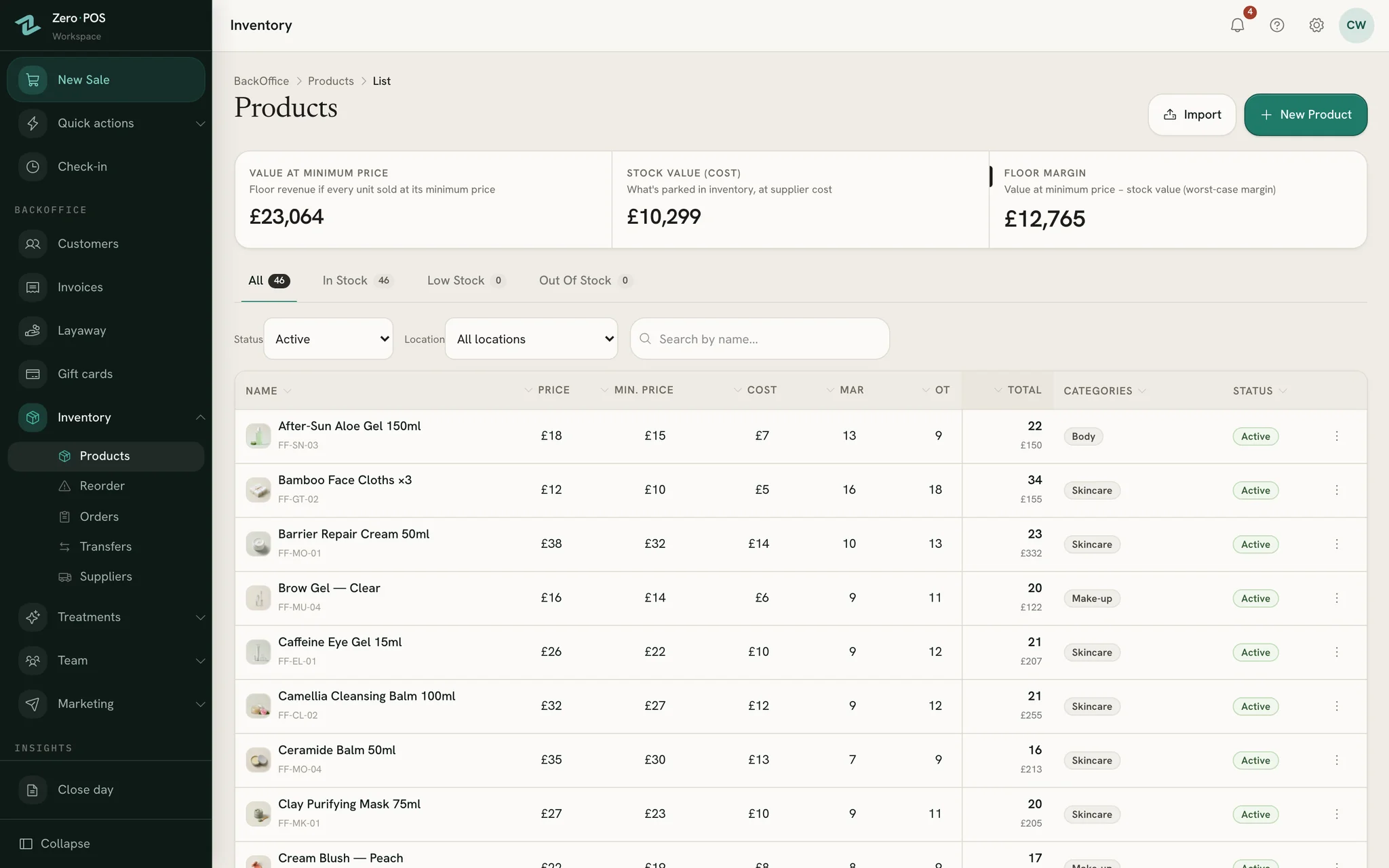
Stock, shop by shop. Every tester you record leaves these numbers on the day you open it, instead of turning up as a mystery at the next count.
A tester is a cost, not a loss
Start by calling testers what they are: a marketing cost you choose to pay. A customer who can smell the cream, see the shade on her wrist and feel the texture is far more likely to buy, and to come back for the same one. That is worth paying for.
The trouble starts when nobody records them. An opened unit still sits in the stock figure, so the system thinks you have one more jar than you can sell. The reorder comes late. The next stock take shows the line as short, and somebody wonders about theft. The margin report looks healthier than the till drawer feels. None of it is wrong arithmetic; it is a cost that was paid but never written down.
So the goal is not fewer testers at any price. It is testers you decided to open, written down the day you opened them, and a clear view of what they cost line by line, so you can decide whether each one earns its place.
Work out what a tester really costs
Count a tester at what you paid for it, not at the price on the shelf. The shelf price is money you hoped to take; the cost price is money that actually left the business.
Then compare it with what the product earns. Take an example: a cream that costs you 18 and sells for 45 earns 27 on each sale. One tester opened a month costs 18, so 18 of the first sale’s 27 goes on the tester. A line that sells ten a month shrugs that off. A line that sells two a month spends a third of its profit on its own tester.
That is the sum to keep in mind for every line on the counter: tester cost against the profit the line makes in the same period. Our free markup and margin calculator works out a line’s profit per unit from its cost and price, if you don’t have it to hand.
Slow lines with an expensive tester are where testers really eat margin. Sometimes the answer is a smaller tester, a sample pot filled from one unit, or a tester kept behind the counter and offered by hand instead of left out.
Set a rule for opening them
Tester waste is seldom one big decision. It is a second jar opened because the first was out of reach, a new one opened because the old one looked messy, a shade opened in two shops when one would do. A short written rule stops most of it.
- One tester per product per shop, unless the owner or manager says otherwise.
- A new tester only when the old one is empty, broken or unhygienic, and the old one comes off the counter the same day.
- Only named people open testers, usually whoever runs the shop that day.
- Write the opening date on the base, so you can see how long each one lasts.
- Every tester is recorded before it goes on the counter, not at the end of the week.
Brand-supplied testers, marked as not for sale, are different: they never cost you a sellable unit, so they don’t go into your stock at all. The rule is about opening units you could have sold.
Hygiene helps the margin too. Spatulas, cotton pads and disposable applicators make a tester last longer and stop customers giving up on it, which means fewer replacements.
Record every one, the day you open it
Recording a tester takes a few seconds if it is done at the moment it is opened, and an afternoon of guessing if it is left for later. Treat it like ringing up a sale: the jar is not on the counter until it is written down.
A good record has four things: which product, which shop, how many, and why. “Tester” covers most of them. Keep damaged stock separate: a jar that arrived cracked or a lipstick dropped on the floor is a different cost with a different cure, usually a word with the supplier or a change to how stock is handled, and mixing the two hides both.
Testers that go missing from the counter are a third thing again. If a tester disappears, record it as gone, but note it, because a pattern of missing testers on one line is worth knowing about.
Keep testers out of the count
At a stock take, open testers are not stock. Count sealed, sellable units only. If testers were recorded when they were opened, the shelf and the system agree. If they were not, every unrecorded tester shows up as a missing unit, and the count tells a story about theft that never happened.
That is why a good habit before any count is to walk the counter, check that every tester out there has been recorded, and record the ones that haven’t, then count. Our guide to doing a stock take covers the rest of the preparation.
Review them once a month
Once testers are recorded, they become something you can manage rather than something you suspect. Once a month, look at three things.
Which lines used the most testers, in units and at cost.
Which shop opened more testers than the other for the same lines.
Which lines spent a large share of their profit on testers, set against what they sold.
Then act on what you find. A line that burns through testers and sells well is fine; leave it. A line that burns through testers and sells little needs a smaller tester or a different place on the counter. A shop that opens twice as many testers as its neighbour for the same products usually has a habit worth a conversation, not a thief.
Doing it in Zero POS
Because testers are recorded as they are opened, a blind stock take compares like with like, and the lines that are really short stand out. Testers, transfers, counts and reorders are all part of stock control in Zero POS.