Treatments and gifts
How to price a facial from what it really costs
It is tempting to price a facial by looking at the salon down the road and taking a little off. That tells you what people will pay, not whether you make anything when they do. Start from your own costs, then look at the market: you will know which treatments are carrying the room and which are quietly costing you.
By The Zero POS teamChecked 6 min read
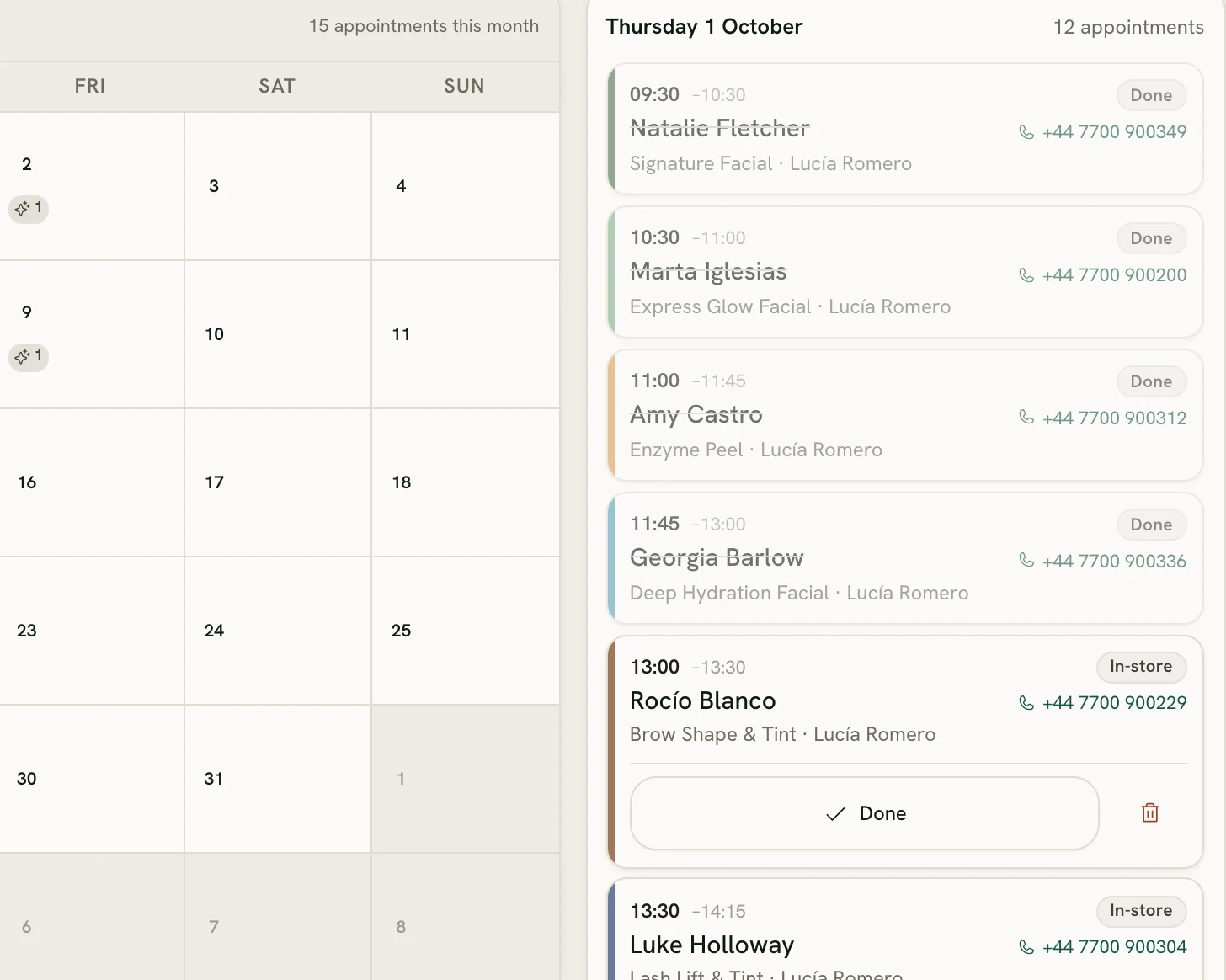
A day in the treatment diary. Each treatment’s length decides how much of the room’s time it takes, which is half of what it costs.
Two costs in every facial
Every treatment has two kinds of cost. The products: what goes on the client’s skin and what gets thrown away afterwards. And the time: the therapist’s pay for those minutes, plus the room’s share of everything that keeps it open. In almost every facial the time costs far more than the products, which is why pricing from the products alone loses money.
Cost the products per treatment
Go through the trolley for one treatment and cost each product by the amount one client uses, at what you paid for it. A cleanser that costs you 24 for 200 ml, used at 5 ml a time, costs 0.60 per facial. Do the same for the toner, the mask, the serum, the moisturiser and the eye cream.
Then add the consumables people forget: cotton pads, spatulas, a sheet mask, the headband, the laundry for towels and the couch cover. Each is small, together they are not. If you’re unsure of the amounts, weigh a bottle at the start and end of a week and divide by the number of facials.
For the examples below, say the products and consumables for a signature facial come to 7.50.
Cost the time: the slot, not just the treatment
Price the slot the facial takes from the diary, not just the minutes the client is on the couch. A 50-minute facial with a short consultation, clean-up and changeover blocks an hour. That hour is what nobody else can book.
Next, work out what an hour of the room costs you. Add up a normal month of what the treatment side spends: the therapists’ pay, the room’s share of rent, power, insurance, laundry, booking and software costs. Divide by the hours the room is actually busy in a month, not the hours it is open. A room open 200 hours a month but booked for 120 has to earn its keep in those 120.
Say that comes to 30 an hour. Our signature facial, in its one-hour slot, then costs 30 of time plus 7.50 of products: 37.50 to give.
From cost to the price on the menu
Decide what margin you need: the share of the price that is left once the cost is paid. Then divide the cost by what remains: price = cost ÷ (1 − margin). At a 40% margin, 37.50 ÷ 0.6 = 62.50 before tax.
Don’t confuse margin with markup. Adding 40% to the cost gives 52.50, which is only a 29% margin. That one mistake is an easy way to underprice a whole treatment menu.
If your menu shows prices with tax, add it on top: at a 10% tax, 62.50 becomes 68.75, which you might round to 69. If you charge no VAT or IGI, the price before tax is the price. Our free treatment price calculator does these sums with your own figures, and the VAT calculator adds or removes the tax.
Compare treatments by profit per hour
Once each treatment has a cost and a price, look at what it leaves for every hour of the room, because the room’s hours are what you run out of.
- The signature facial: priced at 62.50 before tax, costing 37.50, leaves 25 in its one-hour slot: 25 an hour.
- An express facial: products 4, a 40-minute slot costing 20, so 24 to give. Priced at 40 before tax, it leaves 16 for its 40-minute slot: 24 an hour.
Two very different prices, almost the same earnings per hour. That changes how you think about your menu: an express facial isn’t a cheap version of the real thing, it is a way to fill a 40-minute gap in the diary. A long treatment with a high price that leaves less per hour than a short one needs either a higher price or a shorter slot.
Then look at the market
Now compare with what others nearby charge for similar treatments, and be honest about what is similar: the length, the products used, the setting, the experience of the therapist. Being the cheapest is rarely the goal. A price far below the area can make people wonder what is missing.
If the market price is below your cost, that is useful to know. Change what the treatment includes, shorten the slot, or let it go and put the time into treatments that pay. Don’t keep a treatment on the menu at a loss because everyone else has it.
Discounts, add-ons and the retail that follows
Set a floor before you set a discount. Know the lowest price at which a facial still covers its cost, and don’t go under it without deciding to. Introductory offers are fine; an offer that quietly becomes the normal price is not.
Add-ons, such as an eye treatment or an extra mask, often earn more per minute than the facial itself, because the room and the client are already there. Price them the same way, from products and minutes.
Finally, count what a facial sells afterwards. A client who loved the serum used on her skin often buys it on the way out. That sale isn’t part of the facial’s price, but it is part of why the treatment room is worth having.
Look at the menu again every year
Costs move. Product prices go up, pay goes up, rent is renewed, and a facial priced well two years ago may now leave very little. Once a year, and whenever a big cost changes, run the same sums again: products per treatment, the cost of an hour, the margin, the price. It takes an evening and it is the only way to know.
When a price has to rise, raise it cleanly and tell your regulars before they see it on the menu. A small rise every year or so is easier for clients to accept than a big one after several years of nothing. Look at the diary at the same time: a treatment nobody books at any price is using up space on the menu, and the time it would take is better given to the ones that fill.
Doing it in Zero POS
The steps are in turn on treatments and treatments at the till. The diary, the booking link and the till side by side are on the online booking page.